

The Fifth Competition


The 5th Belt and Road Initiative Simulation Competition Concludes Successfully at the University of Reading
On August 10, 2026, the 5th Belt and Road Initiative Simulation Competition was successfully held at the University of Reading in the United Kingdom. The competition was jointly organised by the Foundation for Law and International Affairs (FLIA) and the University of Reading School of Law, with generous sponsorship and support from Mengchun Zhang, Partner at JunZeJun Law Offices; Xiangran Meng, Partner at AllBright Law Offices; and New Horizon Global Advisory Ltd.
This year’s competition brought together more than 50 students in eight teams from 13 universities across China, the United Kingdom and Ireland. Participating students came from Jiangxi University of Finance and Economics, Zhejiang Normal University, Ocean University of China, University of Electronic Science and Technology of China, Shihezi University, Tianjin Foreign Studies University, East China University of Political Science and Law, Fudan University, Tongji University, Shanghai University of Political Science and Law, Gansu University of Political Science and Law, University College Cork, and the University of Reading. Several teams brought together students from different institutions, further strengthening the competition’s emphasis on openness, diversity and cross-university collaboration.

Negotiating the Freshippo Village Project in Uganda
At the centre of this year’s competition was the hypothetical “Freshippo Village Project” in Uganda, a complex international investment project involving multiple stakeholders and competing interests.
Participants were asked to negotiate a wide range of interconnected issues, including the project’s investment and ownership structure, supply-chain management, pricing mechanisms, local employment and economic impact, institutional cooperation, standards and certification, and environmental sustainability. Working within a defined factual scenario and a set of stakeholder-specific interests and constraints, participants were challenged to develop practical solutions through negotiation and cooperation.
The teams represented four major stakeholders:
-
The Government of Uganda
-
Alibaba Group Holding Limited
-
United Nations Industrial Development Organization (UNIDO)
-
World Union of Small and Medium Enterprises (WUSME)
Throughout the simulation, participants were expected to remain faithful to the interests and institutional position of the stakeholder they represented, while at the same time identifying opportunities for collaboration and compromise.
The exercise reflected one of the central features of the BRI Simulation Competition: international projects rarely involve a single legal, commercial or policy issue. Instead, participants must navigate the different priorities of governments, businesses, international organisations and civil society while working towards solutions that can command broader support.
From Bilateral Consultations to Quadrilateral Negotiations
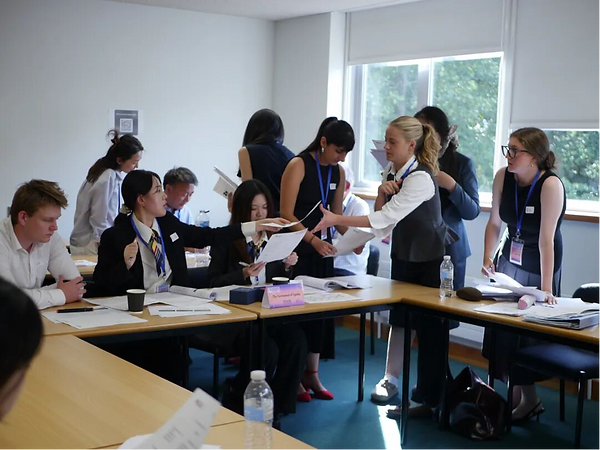
The competition consisted of two rounds of negotiations, held in parallel sessions in the morning and afternoon.
Each round began with Opening Statements, followed by Pre-scheduled Bilateral Negotiations, Ad Hoc Negotiations, a final Quadrilateral Negotiation, and the drafting and signing of a Resolution.
During the bilateral and ad hoc negotiation stages, teams tested each other’s positions, explored potential agreements, developed proposals and identified possible partners. The quadrilateral negotiation then brought all four stakeholders to the same table, requiring them to address unresolved issues and work towards a shared outcome.
The final resolution was assessed not simply on whether an agreement had been reached, but also on the clarity, feasibility, legal reasoning and degree of consensus reflected in the negotiated outcome.
The dynamic structure required participants to constantly reassess their strategies. Agreements reached in one bilateral negotiation could affect discussions with another stakeholder, while new proposals emerging during ad hoc negotiations could reshape the possibilities available at the final negotiation table. In this way, the competition sought to recreate the uncertainty, strategic decision-making and coalition-building that characterise real-world international negotiations.

Expert Evaluation: Strategy, Legal Reasoning and Collaboration
The competition was supported by a distinguished group of scholars and practitioners who served as negotiation judges and written-submission judges.
The judging panel included Professor Ming Du of Durham Law School; Ian Wood-Smith, Partner at Field Seymour Parkes; Juncheng Liang, Partner at New Horizon Global Advisory Ltd.; Francesco De Pascalis, Senior Lecturer in Financial Law at Brunel University of London; Asen Velinov, Director of the Research Institute for Business Environment and Rule of Law at Wenzhou-Kean University; Cai Min, a risk prevention and control expert at Bank of China; Xiangran Meng, Partner at AllBright Law Offices; Jing Wang, lawyer at Shakespeare Martineau; and Associate Professor Shaoping Jiang of Zhejiang A&F University.
Through live observation and written assessment, the judges evaluated participants across a range of areas, including negotiation strategy, communication and presentation, legal advocacy, advancement of stakeholder interests, problem-solving, and the ability to contribute to the development of a final agreement.
Awards and Recognition
Following a full day of intensive negotiations and deliberation by the judges, the following awards were presented:
Team Awards
Gold Award: Zhejiang Normal University
Silver Award: University College Cork
Bronze Award: Ocean University of China
Individual Awards
Diplomacy Award:
-
Finbarr Murphy
-
Jiayi Zhao
-
Chenli Hu
Public Speaking Award
-
Jiangji Ge
-
Ali Shefif
-
Di Zhang
-
Chenli Hu
Law Advocacy Award
-
Tatjana Farjadi
-
Jiajing Ge
-
Lingyu Zhang
-
Di Zhang
Excellent Opening Statement
-
University of Electronic Science and Technology of China
-
Jiangxi University of Finance and Economics
The awards recognised not only overall team performance, but also the different professional skills required in international negotiation—from persuasive advocacy and public speaking to diplomacy, coalition-building and effective written communication.


Developing Global Talent Through Experiential Learning
As international cooperation becomes increasingly characterised by multiple stakeholders, overlapping interests and interdisciplinary challenges, professional knowledge alone is rarely sufficient.
The Belt and Road Initiative Simulation Competition seeks to place students in complex and realistic negotiating environments where they must do more than formulate legal or policy arguments. Participants must learn to listen, communicate, negotiate, compromise, build alliances and transform competing interests into workable solutions.
This approach reflects the broader educational mission of the BRI Simulation Program, which combines experiential learning with practical application and encourages participants to develop skills across law, international affairs, business, policy and cross-cultural communication.
Dr. Shaoming Zhu, Founder and President of FLIA, explained that the value of negotiation simulations lies not simply in giving students an opportunity to demonstrate the legal knowledge they have already acquired.
Rather, students are placed within a complex decision-making environment in which governments, businesses, international organisations and civil society organisations all have different interests and constraints. They must learn to understand these different perspectives and, while protecting the interests of the stakeholder they represent, identify areas in which cooperation remains possible.
Through this practical and interdisciplinary approach, the BRI Simulation Competition aims to equip young people with the communication, negotiation and problem-solving skills required for future participation in international affairs and global governance.
Bringing Law Back into the Real World
Professor Mark Poustie, Head of the University of Reading School of Law, welcomed students from different countries and universities to Reading and expressed his pleasure that the School was able to host the fifth competition. He emphasised that one of the key benefits of simulation-based education is that it requires students to place law back into its real-world context.
Zhenqiu Qian, coach of the Zhejiang Normal University team, highlighted the value of international negotiation simulations in developing students’ professional competence, cross-cultural communication skills and practical understanding of international affairs.
He noted that such simulations allow students to gain a more direct understanding of how international organisations operate and how international cooperation works in practice. A student from Zhejiang Normal University who participated in the previous BRI Simulation Competition subsequently secured an internship opportunity with a United Nations agency—an achievement closely connected to the learning and development gained through the competition. The experience illustrates how practice-oriented international education can contribute not only to academic learning, but also to students’ longer-term professional development and ability to work in international environments.

Looking Ahead
Over the course of a single day, students from different universities experienced the full negotiation process—from articulating positions and exchanging interests to adjusting proposals and ultimately working towards consensus.
By holding the fifth competition at the University of Reading, the BRI Simulation Competition has further expanded its international participation and continued the program’s development as a platform for experiential and interdisciplinary education.
Looking ahead, the competition will continue to create opportunities for students and young professionals to engage with realistic international issues, work alongside participants from different academic and cultural backgrounds, and develop the skills required to address increasingly complex challenges in international cooperation.
We also extend sincere thanks to University of Reading PhD researchers Lan Ma, Jiaqi Li and Yusuf Beggi, and Psychology PhD researcher Asaf Ali Altun, for their valuable assistance and support throughout the competition.
Let’s Work Together
Contact us at contact@flia.org for more information.


